
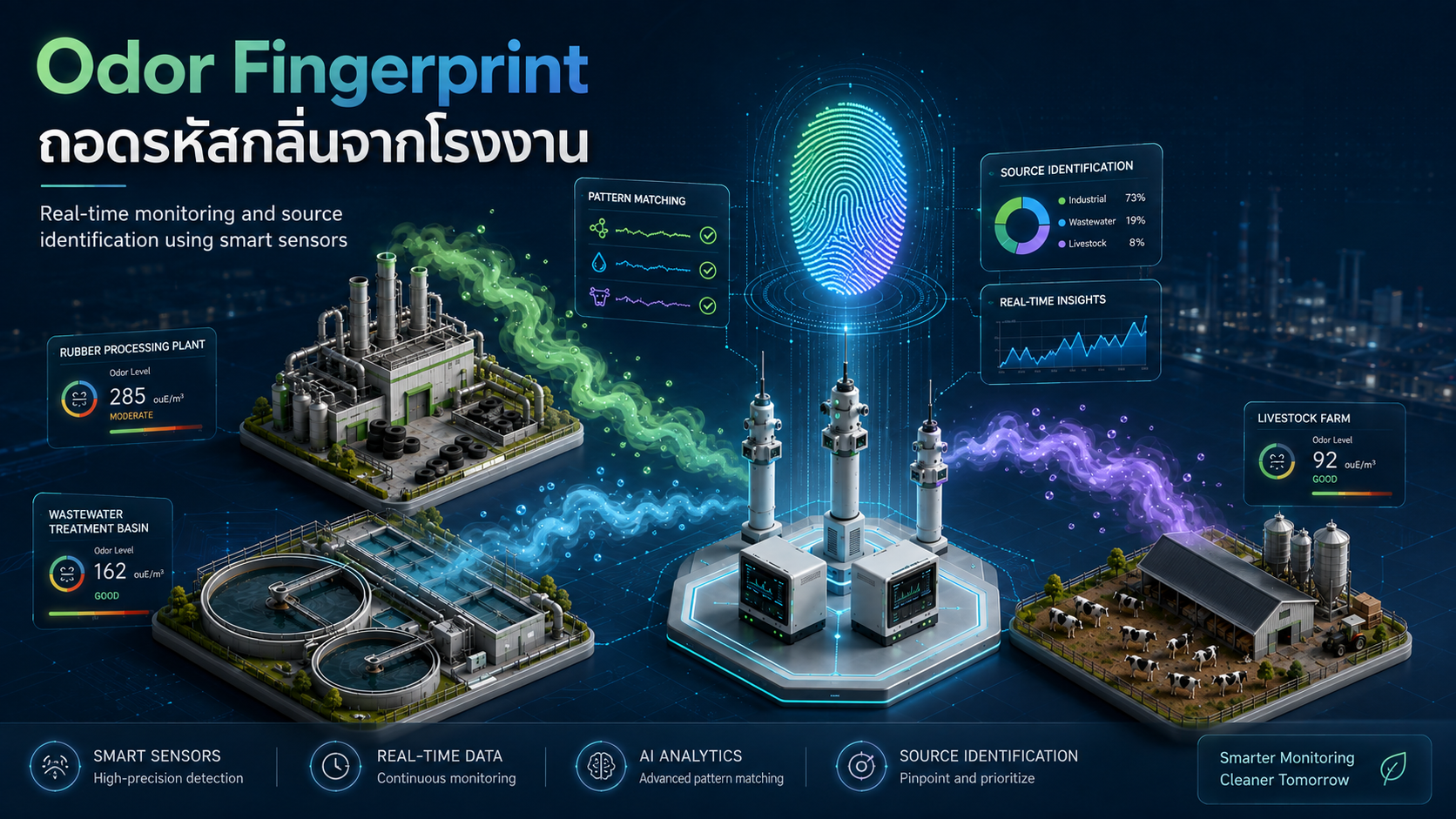
Technology that characterizes odors to help identify sources and manage complaints.
Where several operators are located close together, an odour dispute usually comes down to one question: “Whose odour is this?” The question is difficult to answer because, by the time an odour reaches a community, it has been diluted and mixed to the point that the human nose cannot separate its sources. Standard odour-concentration measurement tells us only “how strong is it?”, not “where did it come from?”
An Odour Fingerprint is an approach intended to answer the latter question. It relies on the fact that different types of sources emit different mixtures of volatile compounds and therefore produce different sensor-response patterns. This article explains how the technology actually works, what it can and cannot do, and what operators should consider before deciding whether the investment is worthwhile.
The correct definition of an Odour Fingerprint
An Odour Fingerprint is a distinctive pattern used to represent the “identity” of an odour from a particular source. It is built from two layers of information.
- Sensor-array response pattern: the set of signal changes produced by multiple sensors exposed to the same air sample. No individual sensor is specific to a single compound, but the combined response of the array produces a pattern characteristic of that odour mixture.
- Chemical profile: the relative proportions of volatile compounds determined by laboratory techniques—for example, the markedly different ratios of sulfur compounds to amines found at livestock farms, natural-rubber plants, and wastewater-treatment systems.
The word “fingerprint” is an analogy, not a forensic claim of uniqueness comparable to a human fingerprint. An odour signature matches a sample against sources that have already been sampled and made known to the system; it is not an absolute identification. The system can classify only sources represented in its training data.
Odour data have four layers—do not confuse them
The most common misunderstanding is to use one layer of odour data as a substitute for another. The table below distinguishes the question answered by each layer and the method used to measure it.
| Data layer | Question answered | Standard method | Unit |
|---|---|---|---|
| Odour concentration | How strong is the odour? | Dynamic olfactometry using a human panel under EN 13725:2022 [1] | ouE/m³ |
| Chemical composition | What compounds make up the odour? | TD-GC-MS, GC-SCD for sulfur compounds, and GC-O coupled with olfactory assessment | µg/m³ or ppbv |
| Signature or fingerprint | Which source does the odour match most closely? | Sensor array combined with pattern recognition [2] | Dimensionless pattern and confidence value |
| Character and annoyance | How do people experience the odour? | Odour descriptors, hedonic tone, and field inspection under VDI 3940 | Qualitative scales |
How the system works, from sensors to an answer
Step 1: Acquiring signals from the sensor array
Most instruments used for environmental odour monitoring contain approximately 6–12 metal-oxide semiconductor (MOS) sensors, supplemented by specialised devices such as electrochemical sensors for H₂S and NH₃ or a photoionisation detector (PID) for total VOCs. Sampling cycles in field systems are generally between 5 and 12 minutes. [2]
Step 2: Preparing the signals
- Baseline correction to remove the effects of short-term signal drift.
- Feature extraction, such as relative resistance change, response-phase slope, and steady-state value.
- Compensation for temperature and humidity, the strongest confounding variables in outdoor operation, particularly in a hot and humid climate. [2]
Step 3: Pattern recognition
This step is the origin of the term fingerprint. The methods fall into three groups according to their purpose.
| Method group | Example techniques | Purpose |
|---|---|---|
| Unsupervised data exploration | PCA and clustering | Determine whether odours from different sources genuinely form distinct groups before investing in a classification system. |
| Supervised classification | LDA, SVM, Random Forest, and neural networks | Identify the source that best matches an air sample and provide a confidence value. |
| Regression for estimation | PLS regression and other regression methods | Estimate odour concentration in ouE/m³ from the signal pattern, calibrated against dynamic olfactometry. [2] |
Step 4: Producing the answer
A usable result should always contain three elements: the assigned source class, the confidence of the classification, and the wind direction at that time. If any element is missing, the information is insufficient for explanation or dispute resolution.
The training set matters more than the sensors
System quality is determined primarily by the data used to train it, not by the number or brand of sensors. A usable training set must cover the following conditions.
- Air samples from every source that must be distinguished, collected directly at each source to obtain a clear pattern.
- A range of operating conditions, including high-production periods, maintenance, and special activities, because the odour pattern changes with operating state.
- A “clean background air without nuisance odour” class, which is often omitted and is a major cause of false alarms.
- Samples under different weather conditions, including the hot and rainy seasons and both daytime and night-time periods, so the model learns the effects of humidity and temperature.
- For odour-concentration estimation, samples collected in parallel with dynamic olfactometry. Internationally referenced frameworks call for approximately 15 or more paired datasets for field validation. [2]
Relevant standards and guidance
| Standard | Scope | Practical significance |
|---|---|---|
| EN 13725:2022 | Odour concentration by dynamic olfactometry and odour emission rate | The revision adds odour emission rate to the title and scope, prescribes calculations for uncertainty, limit of detection, and limit of quantification, requires leak testing of sample bags, and tightens laboratory temperature and humidity conditions. [1] |
| NTA 9055:2012 (Netherlands) | Guidance on training and using electronic noses | Provides general guidance on training methodology but does not set explicit performance criteria. [2] |
| VDI 3518-3:2018 (Germany) | Performance verification of electronic noses | Specifies verification using standard test gases and accepts deviations of approximately 30%. [2] |
| UNI 1605848 (Italy) | Multi-level qualification framework | Uses a quality-assurance-level concept similar to EN 14181, covering manufacturer verification, field validation against dynamic olfactometry, and ongoing quality assurance. [2] |
| VDI 3940 | Field odour inspection by selected assessors | Assesses the frequency of odour perception under real field conditions and provides independent data for checking sensor-system results. |
Source confirmation requires four layers of evidence
Odour classification alone is not sufficient to confirm a source in a dispute. A robust approach combines four layers of evidence.
| Evidence layer | Question answered | Data source |
|---|---|---|
| Odour signature | Which source does the signal pattern match? | Sensor array and classification model |
| Wind direction | Where was the wind coming from at that time? | On-site meteorological station and directional analysis such as the conditional bivariate probability function [3] |
| Timing consistency | Does the event coincide with a specific activity at the suspected source? | Hourly operating logs |
| Quantitative consistency | Is the emission rate required to produce the measured value plausible? | Reverse calculation using a dispersion model [4] |
When all four layers point in the same direction, the conclusion carries enough weight for negotiation and reporting to the regulator. If any layer conflicts with the others, it is a sign that an unidentified source may still be present in the area.
Limitations that must be disclosed
- Sensor-signal drift is widely recognised in the scientific literature as a limitation without a complete solution. Periodic retraining is required to compensate for it, creating an operating cost that must be considered from the outset. [2]
- Humidity and temperature have severe effects in outdoor operation, particularly in hot and humid climates, and require verifiable compensation.
- Field classification accuracy is often substantially lower than laboratory results. Literature reviews report field accuracy of approximately 70%, which is adequate for screening but not for adjudication on its own. [2]
- Environmental odours contain many volatile compounds and are not stable, so there is no reproducible reference material comparable to those used for conventional gas measurement. Quality assurance is therefore more difficult than for other pollutant-monitoring instruments. [2]
- The system cannot classify a source absent from the training set and cannot reliably distinguish two sources with very similar odour compositions—for example, two pig farms using the same manure-management system.
Checklist before deciding to install a system
- Define whether the required answer is “whose odour is it?” or “how strong is the odour?”, because the two questions require different technologies.
- Identify how many sources lie within the area of interest and whether all of them can be accessed for training-sample collection. If access is incomplete, reconsider project feasibility from the outset.
- Confirm that reliable local wind data are available. If not, include a meteorological monitoring station in the project scope.
- Establish a plan for sampling in parallel with dynamic olfactometry, periodic retraining, and the associated annual operating budget.
- Define in advance what action will follow an alert, including the responsible person and response time in the operating procedure.
- State in every document that system results are management information and that legal proof still requires the method prescribed by applicable law.
Key takeaways
- An Odour Fingerprint is a sensor-array response pattern used to match an odour with previously known sources; it is not an absolute identification.
- Source classification and odour-concentration measurement are different tasks. Concentration measurement must still refer to dynamic olfactometry under EN 13725:2022.
- System quality depends primarily on the training set, and sources absent from the training data will be misclassified.
- Robust source confirmation combines four evidence layers: odour signature, wind direction, timing consistency, and quantitative consistency.
- Signal drift and humidity effects are recurring operating costs that require planning, not one-time problems.
Consult an expert
RE-VEAL installs systems for monitoring odours and analysing their sources. The service covers surveying sources in the area, planning sample collection to build the training dataset, linking results with wind data and dispersion models, and preparing reports for complaint response. Contact our team to assess the suitability of the system for your site.
References
- EN 13725:2022. Stationary source emissions — Determination of odour concentration by dynamic olfactometry and odour emission rate. European Committee for Standardization.
- Bax, C., Sironi, S., & Capelli, L. (2019). Evolution of Electronic Noses from Research Objects to Engineered Environmental Odour Monitoring Systems: A Review of Standardization Approaches. Biosensors, 9(2), 75.
- Uria-Tellaetxe, I., & Carslaw, D. C. (2014). Conditional bivariate probability function for source identification. Environmental Modelling & Software, 59, 1–9.
- Developing an odour emission factor for an oil refinery plant using reverse dispersion modeling (2019). Atmospheric Environment, 218.
- VDI 3940. Measurement of odour impact by field inspection. Verein Deutscher Ingenieure.
- Ministerial Regulation Prescribing Odour Standards in Ambient Air from Factories, B.E. 2568 (2025), Royal Thai Government Gazette, Vol. 142, Part 21 A.